Images Abigail Adams Abigail Adams as a Baby
| Abigail Adams | |
|---|---|
 Portrait of Adams by Benjamin Blyth, 1766 | |
| First Lady of the United States | |
| In role March iv, 1797 – March 4, 1801 | |
| President | John Adams |
| Preceded by | Martha Washington |
| Succeeded by | Martha Randolph (interim) |
| Second Lady of the Usa | |
| In role Apr 21, 1789 – March 4, 1797 | |
| Vice President | John Adams |
| Preceded by | Position established |
| Succeeded by | Ann Gerry (1813) |
| Personal details | |
| Born | Abigail Smith (1744-11-11)November eleven, 1744 Weymouth, Massachusetts Bay, British America |
| Died | October 28, 1818(1818-ten-28) (aged 73) Quincy, Massachusetts, U.Southward. |
| Resting place | United Showtime Parish Church Quincy, Massachusetts |
| Spouse(s) | John Adams (thou. ) |
| Children | v, including Abigail, John, Charles, and Thomas |
| Relatives | Adams political family Quincy political family unit |
| Signature |  |
Abigail Adams (née Smith; Nov 22, [O.South. Nov 11] 1744 – Oct 28, 1818) was the wife and closest advisor of John Adams, as well as the mother of John Quincy Adams. She is sometimes considered to have been a Founder of the United states, and is now designated as the second outset lady of the U.s., although this title was not used at the fourth dimension. She and Barbara Bush-league are the only two women to have been married to one U.Southward. president and the female parent of some other.[1]
Adams's life is one of the nigh documented of the Commencement Ladies: she is remembered for the many letters she wrote to her married man while he stayed in Philadelphia, Pennsylvania, during the Continental Congresses. John frequently sought the communication of Abigail on many matters, and their letters are filled with intellectual discussions on government and politics. Her letters also serve as eyewitness accounts of the American Revolutionary War home front end.
Early life and family [edit]
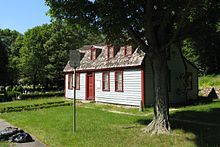
Abigail Adams was born at the North Parish Congregational Church in Weymouth, Massachusetts, to William Smith (1707–1783) and Elizabeth (née Quincy) Smith.[2] On her mother's side, she was descended from the Quincy family, a well-known political family unit in the Massachusetts colony. Through her mother she was a cousin of Dorothy Quincy, who was married to John Hancock. Adams was also the great-granddaughter of John Norton, founding pastor of Old Ship Church in Hingham, Massachusetts, the but remaining 17th-century Puritan meetinghouse in Massachusetts. Smith married Elizabeth Quincy in 1740, and together they had three daughters: Mary born in 1741, Abigail born in 1744 and Elizabeth born on Nov 22, 1744.[3] As with several of her ancestors, Adams's father was a liberal Congregational government minister: a leader in a Yankee club that held its clergy in high esteem. Smith did not focus his preaching on predestination or original sin; instead he emphasized the importance of reason and morality.[4] In July 1775 his wife Elizabeth, with whom he had been married for 35 years, died of smallpox. In 1784, at age 77, Smith died.
Abigail did non receive formal schooling; she was often ill as a child, something which may take been a cistron preventing her from receiving an education.[5] : seven Afterward in life, Adams would also consider that she was deprived an education considering females were rarely given such an opportunity.[5] : vii Although she did not receive a formal education, her mother taught her and her sisters Mary (1739–1811) and Elizabeth (1742–1816, known as Betsy) to read, write and null; her begetter'due south, uncle's and grandfather's large libraries enabled the sisters to study English and French literature.[6] [4] Her grandmother, Elizabeth Quincy, also contributed to Adams's education.[5] : 8 As she grew up, Adams read with friends in an attempt to further her learning.[five] : 8 She became i of the most erudite women ever to serve equally Showtime Lady.[7]
Marriage and children [edit]

Abigail Smith Adams – 1766 portrait by Benjamin Blyth

John Adams – 1766 portrait also past Blyth

Abigail Smith Adams – 1800-1815 portrait by Gilbert Stuart

John Adams – 1800-1815 portrait past Gilbert Stuart
Abigail Smith offset met John Adams when she was 15 years one-time in 1759. John accompanied his friend Richard Cranch to the Smith household. Cranch was engaged to Abigail's older sister, Mary Smith, and they would be the parents of federal judge William Cranch. Adams reported finding the Smith sisters neither "fond, nor frank, nor candid."[8]
Although Adams's father approved of the match, her mother was appalled that her girl would marry a country lawyer whose mode still reeked of the farm, just eventually she gave in. The couple married on October 25, 1764, in the Smiths' home in Weymouth. Smith, Abigail's father, presided over the wedlock of John Adams and his daughter.[ix] After the reception, the couple mounted a single equus caballus and rode off to their new home, the small-scale cottage and subcontract John had inherited from his male parent in Braintree, Massachusetts.[six] Later they moved to Boston, where his law practice expanded. The couple welcomed their kickoff child nine months into their marriage.[6]
In 12 years, she gave birth to half-dozen children:
- Abigail ("Nabby"; 1765–1813)
- John Quincy Adams (1767–1848)
- Grace Susanna ("Susanna", nicknamed "Suky")[10] (1768–1770)
- Charles (1770–1800)
- Thomas Boylston Adams (1772–1832)
- Elizabeth (stillborn in 1777)[11]
Her childrearing style included relentless and continual reminders of what the children owed to virtue and the Adams tradition.[12] Adams was responsible for family unit and farm when her husband was on his long trips. "Alas!", she wrote in December 1773, "How many snow banks divide thee and me." Abigail and John's spousal relationship is well documented through their correspondence and other writings. Letters exchanged throughout John's political obligations indicate his trust in Abigail's knowledge was sincere. Like her husband, Abigail often quoted literature in her letters. Historian David McCullough claims that she did so "more readily" than her husband. Their correspondence illuminated their common emotional and intellectual respect. John ofttimes excused himself to Abigail for his "vanity,"[13] exposing his need for her blessing.
He moved the family to Boston in April 1768, renting a clapboard house on Brattle Street that was known locally as the "White Firm." He and Abigail and the children lived there for a year, then moved to Common cold Lane; still later, they moved again to a larger house in Brattle Foursquare in the middle of the city.[14]
John's growing law practice required changes for the family. In 1771, he moved Abigail and the children to Braintree, but he kept his office in Boston, hoping the time abroad from his family would let him to focus on his work. Yet, later some fourth dimension in the upper-case letter, he became disenchanted with the rural and "vulgar" Braintree as a abode for his family. In August 1772, therefore, Adams moved his family dorsum to Boston. He purchased a large brick house on Queen Street, non far from his office.[xv] In 1774, Abigail and John returned the family to the farm due to the increasingly unstable situation in Boston, and Braintree remained their permanent Massachusetts home.[16]
Abigail as well took responsibility for the family'southward fiscal matters, including investments. Investments made through her uncle Cotton fiber Tufts in debt instruments issued to finance the Revolutionary State of war were rewarded after Alexander Hamilton's First Report on the Public Credit endorsed full federal payment at face up value to holders of government securities.[17] 1 recent researcher even credits Abigail's financial acumen with providing for the Adams family unit'south wealth through the end of John'south lifetime.[17]
Europe [edit]
In 1784, she and her daughter Nabby joined her hubby and her eldest son, John Quincy, at her married man'due south diplomatic postal service in Paris. Abigail had dreaded the thought of the long sea voyage, simply in fact found the journey interesting. At first she institute life in Paris difficult, and was rather overwhelmed past the novel experience of running a large firm with a retinue of servants. However, every bit the months passed she began to enjoy herself: she made numerous friends, discovered a fondness for the theatre and opera, and was fascinated by Parisian women's' fashions, although she ruefully admitted that she "would never be in the style".
Afterwards 1785, she filled the role of wife of the beginning U.S. government minister to the Court of St James's (Britain). In dissimilarity to Paris, Abigail disliked London, where she had few friends and was, in general, cold-shouldered by polite society. I pleasant feel was her temporary guardianship of Thomas Jefferson's young daughter Mary (Polly), for whom Abigail came to feel a deep and lifelong love.
She and John returned in 1788 to their dwelling in Quincy, Peacefield (as well known as the "Old Business firm"), which she prepare about vigorously enlarging and remodeling. It still stands and is open to the public equally part of Adams National Historical Park.[18]
First Lady [edit]

John Adams was inaugurated as the second president of the The states on March 4, 1797, in Philadelphia.[6] Abigail was not present at her husband'southward inauguration every bit she was tending to his dying mother.[6] When John was elected President of the United States, Abigail connected a formal pattern of entertaining.[19] She held a large dinner each week, made frequent public appearances, and provided for entertainment for the city of Philadelphia each Fourth of July.[twenty] : 12 [21]
She took an active role in politics and policy, unlike the quiet presence of Martha Washington. She was so politically agile, her political opponents came to refer to her as "Mrs. President".[half-dozen] As John's confidant, Abigail was often well informed on problems facing her husband's administration, at times including details of current events not yet known to the public in letters to her sister Mary and her son John Quincy.[20] : 11 Some people used Abigail to contact the president.[20] : 12 At times Abigail planted favorable stories well-nigh her hubby in the press.[20] : 12 Abigail remained a staunch supporter of her husband'due south political career, supporting his policies, such equally passing the Alien and Sedition Acts.[20] : 12
Adams brought the children of her brother William Smith, her brother-in-law John Shaw, and her son Charles to alive in the President'south House during her husband's presidency because the children's respective fathers all struggled with alcoholism. Charles's girl, Suzannah, was but 3 years old in 1800 when Adams brought her to alive in the President'southward House in Philadelphia days before Charles'south decease.[22]
With the relocation of the uppercase to Washington, D.C., in 1800, she became the showtime First Lady to reside at the White House, or President's Business firm as information technology was and then known.[23] Adams moved into the White Firm in November 1800, living in that location for only the last four months of her hubby's term.[6] The city was wilderness, the President'due south Business firm far from completion. She found the unfinished mansion in Washington "habitable" and the location "cute"; merely she complained that, despite the thick forest nearby, she could detect no one willing to chop and booty firewood for the First Family. Abigail did utilise the East Room of the White House to hang up the laundry.[24] Adams's health, never robust, suffered in Washington.
Later life [edit]

Abigail and John Adams moved back to Peacefield afterwards John'due south presidency
After John's defeat in his presidential re-ballot entrada, the family retired to Peacefield in Quincy in 1800. Abigail followed her son's political career earnestly, as her letters to her contemporaries show. In afterwards years, she renewed correspondence with Thomas Jefferson, having reached out to him upon the death of his daughter Maria Jefferson Eppes (Polly), whom Abigail had cared for and come to love when Polly was a small child in London, even though Jefferson'southward political opposition to her hubby had hurt her deeply.[6] She connected to enhance her granddaughter Susanna.[six] She also raised her elder grandchildren, including George Washington Adams and a younger John Adams, while John Quincy Adams was minister to Russia. Adams's daughter, Nabby, died of breast cancer in 1813,[25] having endured three years of severe pain.
Death [edit]

Adams died in her home on October 28, 1818,[2] of typhoid fever. She is buried beside her married man and almost their son John Quincy in a crypt located in the United Beginning Parish Church building (also known every bit the "Church of the Presidents") in Quincy, Massachusetts. She was 73 years onetime, exactly 2 weeks shy of her 74th altogether. Her concluding words were, "Do not grieve, my friend, my dearest friend. I am ready to go. And John, information technology volition not be long."
Political viewpoints [edit]
Biographer Lynne Withey argues for her conservatism considering she: "feared revolution; she valued stability, believed that family and religion were the essential props of social society, and considered inequality a social necessity."[26] Her 18th century mindset held that "improved legal and social status for women was not inconsistent with their essentially domestic role."[27]
Women'due south rights [edit]
Abigail Adams wrote about the troubles and concerns she had equally an 18th-century adult female.[28] She was an advocate of married women's property rights and more opportunities for women, particularly in the field of education. Women, she believed, should not submit to laws non fabricated in their interest, nor should they be content with the simple role of existence companions to their husbands. They should educate themselves and thus exist recognized for their intellectual capabilities so they could guide and influence the lives of their children and husbands. She is known for her March 1776 letter to John and the Continental Congress, requesting that they, "remember the ladies, and be more generous and favorable to them than your ancestors. Do not put such unlimited power into the hands of the Husbands. Remember all Men would be tyrants if they could. If particular care and attending is not paid to the Ladies we are determined to foment a Rebellion, and will not hold ourselves bound by any Laws in which we have no phonation, or Representation."[4]

John declined Abigail's "extraordinary code of laws," just acknowledged to Abigail, "We have only the proper name of masters, and rather than surrender this, which would completely field of study us to the despotism of the petticoat, I hope General Washington and all our brave heroes would fight."[29]
Slavery [edit]
Adams believed that slavery was evil and a threat to the American democratic experiment. A letter written by her on March 31, 1776, explained that she doubted well-nigh of the Virginians had such "passion for Liberty" as they claimed they did, since they "deprive[d] their fellow Creatures" of liberty.[4]
A notable incident regarding this happened in Philadelphia in 1791, when a free black youth came to her business firm asking to exist taught how to write. Subsequently, she placed the boy in a local evening school, though non without objections from a neighbour. Adams responded that he was "a Freeman as much as any of the young Men and merely considering his Face is Black, is he to be denied instruction? How is he to be qualified to procure a livelihood? ... I have non idea it whatsoever disgrace to my self to have him into my parlor and teach him both to read and write."[30]
Religious beliefs [edit]
Adams was an active member of Offset Parish Church in Quincy, which became Unitarian in doctrine by 1753.[6] Her theological views evolved over the course of her life. In a letter to her son near the end of her life, dated May 5, 1816, she wrote of her religious beliefs:
I admit myself a unitarian – Assertive that the Male parent alone, is the supreme God, and that Jesus Christ derived his Being, and all his powers and honors from the Father ... At that place is not whatsoever reasoning which tin convince me, contrary to my senses, that three is one, and one three.[4]
She likewise asked Louisa Adams in a alphabetic character dated Jan 3, 1818, "When will Flesh be convinced that true Religion is from the Heart, betwixt Homo and his creator, and non the imposition of Human being or creeds and tests?"[31]
Legacy [edit]
Historian Joseph Ellis has found that the 1,200 letters between John and Abigail "constituted a treasure trove of unexpected intimacy and candor, more revealing than any other correspondence betwixt a prominent American husband and married woman in American history."[32] Ellis (2011) says that Abigail, although cocky-educated, was a better and more colorful letter-writer than John, even though John was one of the best letter-writers of the age. Ellis argues that Abigail was the more resilient and more than emotionally counterbalanced of the two, and calls her one of the most extraordinary women in American history.[32]
Memorials [edit]
| External video | |
|---|---|
 Abigail Adams past Gilbert Stuart Abigail Adams past Gilbert Stuart | |
 "First Lady Abigail Adams", First Ladies: Influence & Paradigm, C-Bridge[33] "First Lady Abigail Adams", First Ladies: Influence & Paradigm, C-Bridge[33] |
The Abigail Adams Cairn – a mound of rough stones – crowns the nearby Penn Colina from which she and her son, John Quincy Adams, watched the Boxing of Bunker Colina and the burning of Charlestown. At that time she was minding the children of Dr. Joseph Warren, president of the Massachusetts Provincial Congress, who was killed in the battle.[34]
An Adams Memorial has been proposed in Washington, D.C., honoring Adams, her husband, her son, and other members of their family.
One of the subpeaks of New Hampshire's Mount Adams (whose principal peak is named for her husband) is named in her honour.[35]
Popular civilization [edit]
Passages from Adams'due south letters to her hubby figured prominently in songs from the Broadway musical 1776.[iv] Virginia Vestoff played Adams in the original 1969 Broadway production of 1776 and recreated the role for the flick version in 1972. On idiot box, Kathryn Walker and Leora Dana portrayed Adams in the 1976 PBS mini-series The Adams Chronicles. In the mini-serial John Adams, which premiered in March 2008 on HBO, she was played by Laura Linney. Linney enjoyed portraying Adams, saying that "she is a woman of both passion and principle."[12] A revolution-era Abigail, circa 1781, is portrayed past Michelle Trachtenberg, on the television series, Sleepy Hollow, in the season ii episode, "Pittura Infamante" (Jan 19, 2015), her aid being crucial in ending a series of unexplained murders from the flow. Adams is a featured figure on Judy Chicago'southward installation piece The Dinner Party, being represented as i of the 999 names on the Heritage Floor. [36] Novelist Barbara Hambly, writing every bit Barbara Hamilton, wrote three historical mysteries fix in the early 1770s told from Abigail Adams' perspective (and featuring Abigail as the detective): The Ninth Girl (2009), A Marked Man (2010), and Sup with the Devil (2011).
Portrait on currency [edit]
The Showtime Spouse Programme under the Presidential $ane Coin Program authorizes the Us Mint to upshot one-half-ounce $ten gold coins and bronze medal duplicates[37] to honor the start spouses of the United States. The Abigail Adams money was released on June 19, 2007, and sold out in but hours. She is pictured on the back of the money writing her most famous letter to John Adams. In Feb 2009 Money World reported that some 2007 Abigail Adams medals were struck using the opposite from the 2008 Louisa Adams medal, evidently by error.[38] These pieces, called mules, were contained inside the 2007 First Spouse medal set.[38] The U.S. Mint has not released an estimate of how many mules were made.
-

Obverse
-

Obverse (bronze medal)
Family tree [edit]
| ||||||||||||||||||||||||||||||||||||||||||||||||||||||||||||||||||||||||||||||||||||||||||||||||||||||||||||||||||||||||||||||||||||||||||||||||||||||||||||||||||||||||||||||||||||||||||||||||||||||||||||||||||||||||||||||||||||||||||||||||||||||||||||||||||||||||||||||||||||||||||||||||||||||||||||||||||||||||||||||||||||||||||||||||||||||||||||||||||||||||||||||||||||||||||||||||||||||||||||||||||||||||||||||||||||||||||||||||||||||||||||||||||||||||||||||||||||||||||||||||||||||||||||||||||||||||||||||||||||||||||||||||||||||||||||||||||||||||||||||||||||||||||||||
References [edit]
- ^ "Barbara Bush-league, dame of Bush-league dynasty, dies at 92". David Cohen. Politico. Apr 17, 2018. Retrieved November 27, 2019.
- ^ a b Cullen-DuPont, Kathryn (2000). Encyclopedia of women's history in America. Infobase Publishing. pp. 3–4. ISBN978-0-8160-4100-viii.
- ^ "American Feel | John & Abigail Adams | People & Events". PBS. Retrieved September vii, 2016.
- ^ a b c d e f "Abigail Adams". Apr 21, 2001. Archived from the original on April 21, 2001.
- ^ a b c d Holton, Woody (2010). Abigail Adams. Simon and Schuster. ISBN9781451607369.
- ^ a b c d e f grand h i j "Abigail Adams Biography". Firstladies.org. National First Ladies' Library. Retrieved September seven, 2016.
- ^ Withey, ch. 1
- ^ McCullough 2001, pp. 51–52.
- ^ "Abigail Adams Biography – Adams National Historical Park". www.nps.gov. U.Due south. National Park Service. Retrieved Nov 16, 2016.
- ^ Gilles, Edith Belle (2002). Abigail Adams: A Writing in Life. Routledge. p. xv. ISBN978-0-415-93945-4.
- ^ 1000. J. Barker-Benfield (2012). "Stillbirth and Sensibility The Example of Abigail and John Adams". Early American Studies. ten (i): 2–29. doi:10.1353/eam.2012.0003. JSTOR 23546680. S2CID 145021243.
- ^ a b Garry Wills, Henry Adams and the Making of America, 2005; p. 24; Wills cites the criticisms of Paul Nagel "and others"
- ^ McCullough 2001, p. 272.
- ^ Ferling, John (1992). John Adams: A Life. University of Tennessee Press. ISBN 0-87049-730-8. [ebook] ch. 3
- ^ Ferling, John (1992). John Adams: A Life. Academy of Tennessee Press. ISBN 0-87049-730-8. [ebook] ch. 4
- ^ "American Experience – John & Abigail Adams – Timeline – PBS". pbs.org . Retrieved September vii, 2015.
- ^ a b Saxton, Martha (November 1, 2010). "Abigail Adams, Capitalist". Women's Review of Books . Retrieved Oct 27, 2017.
- ^ "Basic Data – Adams National Historical Park (U.Due south. National Park Service)". world wide web.nps.gov . Retrieved November sixteen, 2016.
- ^ "Abigail Smith Adams". whitehouse.gov. 2014. Retrieved November 17, 2016.
- ^ a b c d east Seale, William; Association, White House Historical (2002). The White Business firm: Actors and Observers. UPNE. ISBN9781555535476.
- ^ Encyclopædia Britannica (2007). Founding Fathers: The Essential Guide to the Men Who Made America. Hoboken: John Wiley and Sons. ISBN978-0470117927.
- ^ Anthony, Carl Sferrazza (2000). America'due south Outset Families: An Inside View of 200 Years of Private Life in the White House. Simon and Schuster. ISBN9780684864426.
- ^ "John Adams moves into White House - Nov 01, 1800 - HISTORY.com". HISTORY.com . Retrieved November 17, 2016.
- ^ "Abigail Adams used the East Room to dry the laundry". Whitehousehistory.org. White House Historical Association. Retrieved September 7, 2016.
- ^ "American Experience | John & Abigail Adams | People & Events | PBS". www.pbs.org . Retrieved November 17, 2016.
- ^ Withey, p. x.
- ^ Withey, p. 82.
- ^ Gelles, Edith Belle (1995). Portia: The World of Abigail Adams. Indiana University Printing. ISBN978-0-253-21023-4. [ folio needed ]
- ^ Adams, John; Adams, Abigail (March–May 1776). "Messages of Abigail Adams". Messages Between Abigail Adams and Her Husband John Adams. liz library.
- ^ "Letter from Abigail Adams to John Adams, 13 February 1797". Adams Family Papers: An Electronic Archive. Massachusetts Historical Society.
- ^ "From Abigail Smith Adams to Louisa Catherine Johnson Adams, 3 …". Founders.archives.gov. July 12, 2016. Retrieved September 7, 2016.
- ^ a b Cited in Wood (2011)
- ^ "Beginning Lady Abigail Adams". C‑SPAN. March 4, 2013. Retrieved November 2, 2014.
- ^ Holton, Woody (2009). Abigail Adams. New York, NY: Free Press Sectionalisation of Simon & Schuster. p. 79. ISBN978-1-4165-4680-1.
- ^ Taylor, Bethany (2011). "Abigail Adams Joins the Presidential Range". Appalachia. Appalachian Mountain Club. 62 (2): 132.
- ^ Chicago, Judy (2007). The Dinner Party: From Creation to Preservation. London: Merrell. p. 169. ISBN 1-85894-370-1
- ^ U.South. Mint: First Spouse Program. Accessed June 27, 2008. "The Usa Mint also produces and brand available to the public bronze medal duplicates of the Get-go Spouse Gold Coins."
- ^ a b Gilkes, Paul (February xvi, 2009). "First Spouse medals set holds Adams mule". Coin World. fifty (2549): one.
Some collectors have begun receiving a First Spouse medal mule – a piece begetting the obverse for Abigail Adams and a opposite intended for the Louisa Adams medal. The mules surfaced in some of the 2007 First Spouse sets...
Bibliography [edit]
Secondary sources [edit]
- Abrams, Jeanne East. Outset Ladies of the Republic: Martha Washington, Abigail Adams, Dolley Madison, and the Creation of an Iconic American Function (NYU Press, 2018).
- Barker-Benfield, G.J. Abigail and John Adams: The Americanization of Sensibility (University of Chicago Press; 2010).
- Bober, Natalie S. 1995. Abigail Adams: Witness to a revolution New York: Simon & Schuster Children'south Publishing Division.
- Ellis, Joseph J. Starting time Family unit: Abigail and John Adams (New York: Alfred A. Knopf, 2010).
- Gelles, Edith B. Portia: The World of Abigail Adams (Bloomington: Indiana University Press, 1991).
- ——. First Thoughts: Life and Letters of Abigail Adams (New York: Twayne Publishers, 1998), reissued as Abigail Adams: A Writing Life (London and New York: Routledge, 2002).
- ——. "The Adamses Retire." Early American Studies 4.1 (2006): 1–15.
- ——. Abigail and John: Portrait of a Matrimony (New York: William Morrow, 2009) – finalist for the 2010 George Washington Book Prize.
- Holton, Woody. Abigail Adams: A Life (New York: Free Press, 2009) – winner of the 2010 Bancroft Prize.
- Kaminski, John P., editor The Quotable Abigail Adams (Cambridge, MA: Belknap Printing of Harvard University Press, 2009).
- McCullough, David (2001). John Adams . New York: Simon & Schuster. p. 144. ISBN978-1-4165-7588-7.
- Nagel, Paul C. 1987. The Adams Women: Abigail and Louisa Adams, Their Sisters and Daughters. New York: {Oxford Academy Press}. ISBN 0-19-503874-vi
- Shields, David S., and Fredrika J. Teute. "The Court of Abigail Adams." Periodical of the Early Republic 35.2 (2015): 227–235.
- Waldstreicher, David, ed. A Companion to John Adams and John Quincy Adams (2013)
- Withey, Lynne (1981). Dearest Friend: A Life of Abigail Adams.
Historiography [edit]
- Crane, Elaine Forman. "Abigail Adams and Feminism." in David Waldstreicher, ed. A Companion to John Adams and John Quincy Adams (2013) pp 199-
- Hogan, Margaret A. "Abigail Adams: The Life and the biographers." in David Waldstreicher, ed. A Companion to John Adams and John Quincy Adams (2013) pp 218–38.
- Woods, Gordon S. "Those Sentimental Americans," New York Review of Books May 12, 2011 online
Chief sources [edit]
- The Letters of John and Abigail Adams ed by Frank Shuffelton (2003).
- Founders Online, searchable edition
- Adams Papers Editorial Projection
External links [edit]
- Short summary of Abigail's Life
-
 Texts on Wikisource:
 - Alphabetic character to Abigail Adams – June 21, 1785, from Thomas Jefferson
- Alphabetic character to Abigail Adams – September 25, 1785, from Thomas Jefferson
- Letter to Abigail Adams – February 22, 1787, from Thomas Jefferson
- "Abigail Adams, Mrs. Smith, Mrs. Shaw, Mrs. Cranch, Elizabeth Clay" in The Women of the American Revolution by Elizabeth F. Ellet (1849)
- "Adams, Abigail". Appletons' Cyclopædia of American Biography. 1900.
- "Adams, Abigail Smith". New International Encyclopedia. 1905.
- "Adams, Abigail". The Biographical Dictionary of America. 1906.
- "Adams, Abigail Smith". Encyclopedia Americana. 1920.
- Works by Abigail Adams at Project Gutenberg
- Works by or about Abigail Adams at Internet Archive
- Works by Abigail Adams at LibriVox (public domain audiobooks)

- Adams family biographies – Massachusetts Historical Gild
- Collection of Abigail Adams Letters
- My Dearest Friend: Letters of Abigail and John Adams, Harvard University Press
- The Adams Women: Abigail and Louisa Adams, Their Sisters and Daughters, Harvard University Press
- Descent from Glory: 4 Generations of the John Adams Family unit, Harvard University Press
- Adams Family unit Correspondence. Cambridge: Harvard Academy Printing
- Abigail Adams Birthplace – Museum in Weymouth, Massachusetts
- Ancestors of Abigail Smith
- Abigail Adams at C-SPAN'south Kickoff Ladies: Influence & Image
- Michals, Debra. "Abigail Adams". National Women's History Museum. 2015.
Source: https://en.wikipedia.org/wiki/Abigail_Adams
0 Response to "Images Abigail Adams Abigail Adams as a Baby"
Post a Comment